BIOMARKER DISCOVERY
N-Glycosylation Profiles of Immunoglobulin G and Future Cardiovascular Events
Hoshi et al.
Circulation Research

1
Objective
The aim of this study was to identify IgG glycan patterns predictive of future cardiovascular disease (CVD) events. Two cohorts were used, one to discover potential glycan markers, and a second, independent cohort was used to validate those findings.
2
Methods
A total of 1,118 IgG glycomes were analyzed to assess associations between IgG glycans and future cardiovascular events.
The discovery cohort included 162 case-control pairs from a primary prevention population—individuals with no prior history of CVD.
The validation cohort included 397 case-control pairs from a secondary prevention population—individuals with a history of CVD at the time of testing.
The discovery cohort included 162 case-control pairs from a primary prevention population—individuals with no prior history of CVD.
The validation cohort included 397 case-control pairs from a secondary prevention population—individuals with a history of CVD at the time of testing.
3
Results
The study identified 6 individual glycans associated with a higher risk of developing CVD in the future.
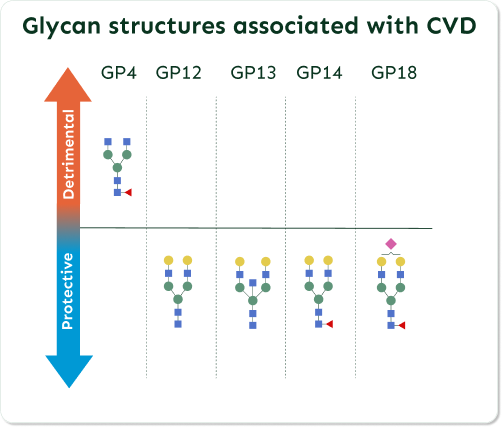
A glycan signature characterized by lower sialylation and galactosylation—two features that influence the inflammatory properties of IgG—was linked to increased CVD risk.
Additionally, a Glycan Score based on four different glycans was developed and shown to improve the prediction of future CVD events when added to existing risk models.
A glycan signature characterized by lower sialylation and galactosylation—two features that influence the inflammatory properties of IgG—was linked to increased CVD risk.
Additionally, a Glycan Score based on four different glycans was developed and shown to improve the prediction of future CVD events when added to existing risk models.
4
Conclusion
These results show the strong potential of IgG glycans as reliable biomarkers for the early detection and prevention of future cardiovascular disease.
Let's Discuss Your Research
Have a project in mind or want to learn more about how glycan analysis can enhance your work? Our scientific team is ready to explore the possibilities with you.