The Best Longevity Gifts for 2027


Find the best longevity gifts for 2027, featuring practical wellness products and research-informed ideas to support healthy aging and everyday vitality.

The best longevity gifts measure something the recipient can change and retest. The strongest options are a biological age test that tracks chronic inflammation, a sleep or recovery wearable for daily trends, and a gift that supports a habit they already keep. Our biological age test is built for the first category: it gives the recipient a baseline number and a way to see whether their habits move it.
This article answers the questions people ask most when choosing a longevity gift, from what counts as a good one to what to avoid.
What makes a good longevity gift?
A good longevity gift gives the recipient a measurable signal and a clear next action. Before you buy, ask whether the recipient can retest or re-measure, and whether the result would change what they do.
Is a biological age test a good gift?
A biological age test is a good gift for anyone who already follows a structured routine and wants to know if it is working. IgG glycans — complex sugars attached to the immune system’s most abundant antibody — are what GlycanAge’s biological age test measures to produce a score, a method first validated in a population study of over 5,000 individuals. The ratio of pro-inflammatory to anti-inflammatory glycans across 29 structures sets that score. The report also includes five glycan indexes, and every result can be booked for a 1:1 interpretation call with a longevity specialist. The test is a lifestyle and clinical biomarker, not a diagnostic.
"What we are looking at is biological aging, but what we’re actually measuring is the age of the immune system.”
— Dr. Julija Jurić, molecular biologist and glycobiology researcher, Genos Glycoscience Research Laboratory
How does the GlycanAge test work for the person receiving it?
The recipient collects four drops of blood from a finger-prick at home and returns the kit by prepaid mailer. Results arrive in three to four weeks and include a biological age score and five glycan indexes. The call that follows is a free 40-minute consultation with a longevity specialist, covering how the recipient’s lifestyle shows up in their biological age, with suggested improvements. Nothing needs to be scheduled with a clinic, which makes it easy to give.
Why choose a glycan-based test over an epigenetic or DNA-based one?
Glycan testing measures current chronic inflammation, while epigenetic clocks read DNA methylation patterns instead of glycans — a distinction confirmed on GlycanAge’s own comparison page.
“Glycans attach to antibodies and regulate inflammation. They’re not only biomarkers — they’re functional effectors that decide whether a specific antibody promotes or suppresses inflammation.”
— Prof. Gordan Lauc, Professor of Biochemistry and Molecular Biology, University of Zagreb, and Co-Founder & Chief Scientific Officer, GlycanAge
GlycanAge reports that an analysis by its partner Alden Scientific found it was virtually the only biological age test able to track individual-level change, staying consistent within roughly a one-year range while epigenetic clocks varied by up to ten years in the same individual over a short period. That reproducibility matters for a gift, because the recipient can read a later change as a real shift rather than lab noise. DNA methylation-based tests, in particular, have a documented problem with technical measurement variance.
Can the recipient actually lower their biological age?
Many repeat testers do: the average biological age reduction across repeat GlycanAge testers is six years.
“It definitely cheered me up — I came out about 16 years younger than my real age, so I loved GlycanAge, I think it’s marvelous. I’ve been tracking it for nearly ten years now, and it’s been pretty constant over that time.”
— Prof. Tim Spector, Professor of Genetic Epidemiology, King’s College London
Examples of interventions that work include HRT, exercise, dietary changes, and stress reduction. The test is most valuable for people in their 30s or older who are starting new health protocols, perimenopausal or postmenopausal women, people on HRT, and those with normal blood panels who still have symptoms such as persistent fatigue. If your recipient fits one of those profiles, a retest after their new routine is the natural follow-up.
Are sleep trackers and wearables worth gifting alongside it?
Yes, as trend instruments, not as sources of truth. Consumer wearables are accurate for heart rate, within about 3 percent of lab measures, but the same review found VO₂ max readings overestimated by roughly 15 percent during resting tests. Multi-stage sleep classification is markedly less reliable than simple sleep/wake detection, according to a laboratory validation of wearable devices against polysomnography, which found high sensitivity for detecting sleep but lower specificity for detecting wake periods — wearables tend to read quiet wakefulness as sleep. Their value lies in longitudinal use, not single-night accuracy.
Chronic inflammation, which those devices do not capture, is what a GlycanAge test measures. A wearable measures daily physiology — sleep, heart rate variability, recovery. The two answer different questions, so they pair well.
Which longevity gift suits which person?
Match the gift to what the recipient is already working on. For someone managing perimenopause or HRT, GlycanAge’s clinical materials frame the test as an objective signal of whether hormone therapy is producing its intended biological effect, beyond symptomatic relief. For an athlete, a recovery wearable covers daily strain, and a sleep tracker suits people who prioritize rest; WHOOP is frequently singled out as a favorite among athletes with rigorous training schedules. For a recipient who has already tried a DNA test, a biological age test is the natural next step, since it shows how lifestyle is currently affecting inflammation. Those who prefer to study the field before acting might appreciate a selection from the best books on longevity and aging to help them build a new protocol.
What should you avoid when buying a longevity gift?
Avoid gifts that promise outcomes without a measurable signal. Devices that cannot move a validated biomarker or drive a next action add little. Avoid anything framed as reversing aging, because no gift can promise that. Pick tools the recipient can use to track change over time, and be wary of single-night readings treated as verdicts.
How should the recipient use the gift once they have it?
The best sequence is baseline, change, retest. The recipient takes the test, reviews the five indexes on the interpretation call, and chooses one or two habits to adjust. How soon meaningful change shows up depends on the intervention: pharmaceutical and HRT protocols can move the score in 3 to 4 months, while lifestyle interventions typically take 6 to 12 months — so the right retest window depends on which one the recipient is trying. Pairing the result with a wearable that tracks sleep and recovery gives them daily feedback between tests. They should discuss any health concerns with their own clinician, since the result sits alongside clinical history and other health data.
Give a baseline that can be retested
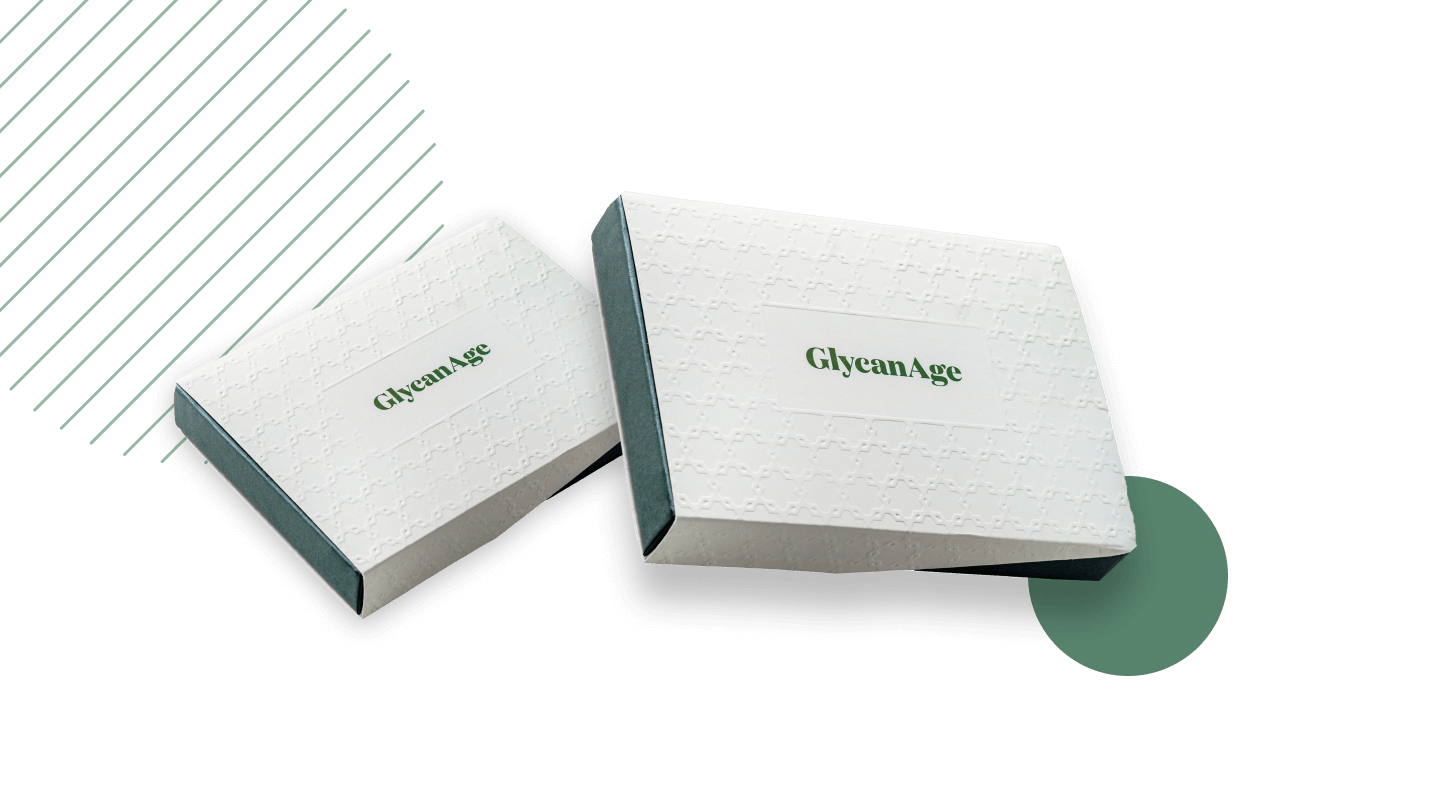
If you want to give a longevity gift with a measurable result, order a GlycanAge test kit for someone who wants to know whether their habits are working. It arrives at their door, comes with a 1:1 interpretation call they can book once results are in, and gives them a number to improve and retest.
External sources
Krištić J, Vučković F, Menni C, Klarić L, Keser T, Beceheli I, et al. Glycans are a novel biomarker of chronological and biological ages. J Gerontol A Biol Sci Med Sci. 2014;69(7):779–89. Available from: https://pmc.ncbi.nlm.nih.gov/articles/4049143
DNA methylation technical variance study. PMCID: PMC9586209; PMID: 36277076. Available from: https://pmc.ncbi.nlm.nih.gov/articles/PMC9586209
Doherty C, Baldwin M, Keogh A, Caulfield B, Argent R. Keeping Pace with Wearables: A Living Umbrella Review of Systematic Reviews Evaluating the Accuracy of Consumer Wearable Technologies in Health Measurement. Sports Med. 2024. doi:10.1007/s40279-024-02077-2. Available from: https://pmc.ncbi.nlm.nih.gov/articles/PMC11560992/
Miller DJ, Sargent C, Roach GD. A Validation of Six Wearable Devices for Estimating Sleep, Heart Rate and Heart Rate Variability in Healthy Adults. Sensors (Basel). 2022;22(16):6317. doi:10.3390/s22166317. Available from: https://pubmed.ncbi.nlm.nih.gov/36016077/
Lifestyle, habits and biological age
Learn how daily choices show up in immune glycans: GlycanAge for personal biological age testing at home, the glycan biological age test explained, and get started with GlycanAge.
The Future of Healthcare is Preventative, Personalised, and Powered by Glycans
Whether you’re improving your own health, supporting patients, or driving research, GlycanAge helps you turn science into action.


How to Give a Biological Age Test as a Gift?
Give a meaningful gift with a biological age test. Learn how to select an option, explain what it measures, and make the experience personal.
Published:November 25, 2026
 Reading time:
10 minutes

Exercise and Inflammation: How Training Load, Recovery and Overtraining Drive Inflammaging
Delve into how training load and recovery influence inflammation in athletes. Learn about the effects of overtraining on the aging process and health.
Published:November 13, 2026
Reading time:15 minutes